
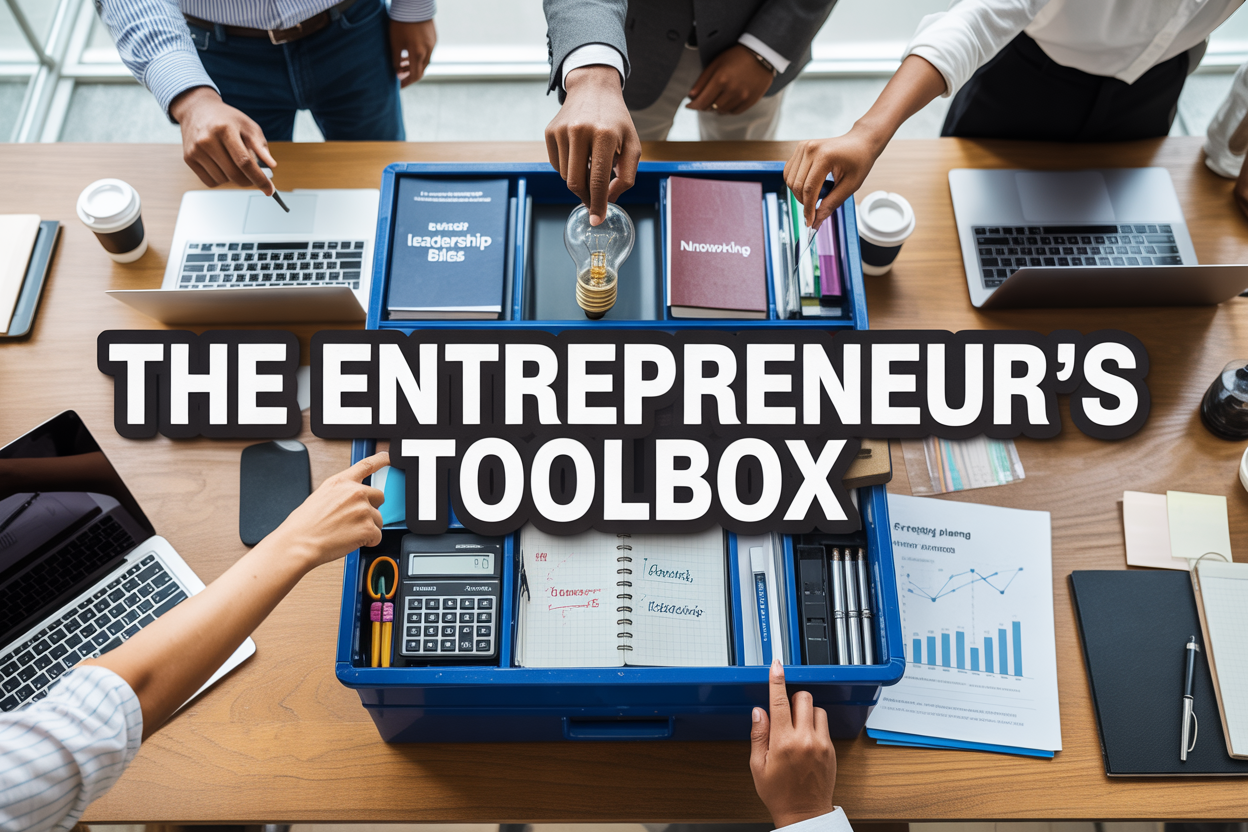
Entrepreneur’s Toolbox: Skills for Excellence
💡 A Kingdom Perspective: Every principle in this post becomes more powerful when grounded in faith. As you read, consider how God’s Word speaks to motivation and perseverance.
Ever watched a business you admired crash and burn while the founder stood bewildered in the wreckage? The cold truth is that 90% of startups fail, and it’s rarely about the idea. Instead, it usually comes down to weak entrepreneur skills.
Success leaves clues. Behind every thriving business stands someone who mastered the entrepreneur skills that separate the dreamers from the doers.
The entrepreneur’s journey demands more than just passion and a clever concept. It requires a specific set of entrepreneur skills that you can develop through deliberate practice and the right guidance.
What if the difference between joining the 10% success club and becoming another statistic often comes down to just five core competencies? And what if the most crucial one isn’t what you think?
Entrepreneur Skills for Mindset Mastery

Developing Resilience for Inevitable Challenges
Ever notice how some entrepreneurs bounce back from failures while others stay down for the count? That’s resilience in action.
Look, running a business is tough. You’ll face rejections, market shifts, and cash flow problems, sometimes all in the same week. However, resilience isn’t about avoiding these challenges. It’s about how quickly you recover from them.
Start building your resilience muscle by:
- Reframing setbacks as learning opportunities
- Developing daily stress management practices
- Building a support network of fellow entrepreneurs
The most successful business owners I know keep a “failure journal” where they document what went wrong and what they learned. Because of this simple habit, disappointments turn into valuable data.
Cultivating a Growth-Oriented Perspective
Your mindset determines your ceiling. Period.
When you believe your abilities can grow through dedication and hard work, opportunities start appearing everywhere. That’s the growth mindset at work.
Think about it: Amazon started as an online bookstore. Netflix mailed DVDs. Both evolved because their founders weren’t locked into fixed thinking.
To develop this perspective:
- Question your assumptions regularly
- Seek feedback, especially the uncomfortable kind
- Invest in continuous learning (courses, books, mentors)
- Celebrate progress, not just outcomes
The entrepreneurs who thrive are curious by nature. They’re constantly asking “What if?” and “Why not?” instead of saying “That’s just how things are done.”
Embracing Calculated Risk-Taking
Risk scares most people. That’s why most people aren’t entrepreneurs.
But here’s the thing: successful business owners aren’t reckless gamblers. Instead, they’re calculated risk-takers who:
- Research thoroughly before deciding
- Test ideas on a small scale first
- Set clear boundaries for acceptable losses
- Have contingency plans ready
So what’s the biggest risk? Playing it too safe. While your competitors innovate, you stagnate.
Start practicing smaller risks daily. Make that call you’ve been avoiding. Pitch that idea in the meeting. Each small win builds confidence for bigger leaps later.
Maintaining Work-Life Harmony
Burnout isn’t a badge of honor. It’s a business killer.
The old hustle culture myth of working 24/7 is just that: a myth. Sustainable success requires energy management, not just time management.
Smart entrepreneurs create systems that support their wellbeing:
- Clear boundaries between work and personal time
- Regular unplugged periods (yes, away from your phone)
- Physical activity scheduled as non-negotiable appointments
- Relationships that fuel rather than drain you
Your business is a marathon, not a sprint. As a result, the quality of your decisions decreases dramatically when you’re exhausted, stressed, or isolated.
Remember: your business serves your life, not the other way around.
Financial Acumen: An Essential Entrepreneur Skill for Growth

A. Budgeting Strategies for Early-Stage Ventures
Money’s tight when you’re starting out. That’s just reality. But smart entrepreneurs know how to stretch every dollar.
Start with a zero-based budget. Don’t just copy last month’s numbers. Instead, question every expense. “Do we really need this?” should be your mantra.
The 50/30/20 rule works wonders for new businesses:
- 50% on essential operations
- 30% on growth initiatives
- 20% in reserve for surprises (and trust me, there will be surprises)
Keep your burn rate low. Fancy offices? Nope. Expensive software? Try free versions first. Staff parties? Make them potlucks.
B. Understanding Investment Options and Funding Sources
Bootstrapping isn’t your only option. Money’s out there if you know where to look.
Angel investors want big ideas and passionate founders. As a result, they’ll take risks VCs won’t.
Crowdfunding works if your product has consumer appeal. But it’s not free money, since those backers expect results.
Grants and competitions fly under the radar. They don’t require giving up equity, which is huge.
SBA loans offer better terms than credit cards. Yes, there’s paperwork. Do it anyway.
Don’t chase just any money. Instead, find smart money: investors who bring connections and expertise along with their cash.
C. Cash Flow Management Techniques
Cash flow kills more businesses than bad products do. Hard truth.
Invoice promptly. Like, same-day promptly. And follow up on late payments immediately.
Negotiate longer payment terms with suppliers while offering discounts to customers who pay quickly. That gap is your breathing room.
Create a weekly cash flow forecast. Not monthly, weekly. Know exactly when money’s coming in and going out.
Inventory ties up cash. Keep it lean. The “just in time” approach isn’t just for big manufacturers.
Consider factoring or invoice financing during growth spurts when you need quick cash.
D. Profit Maximization Without Compromising Quality
Higher prices aren’t the only path to better profits.
Small efficiency gains add up fast. Cut meeting times in half. Automate repetitive tasks. Batch similar work.
Analyze which customers actually make you money. Some high-maintenance clients cost more to serve than they’re worth.
Test pricing regularly. Most entrepreneurs undercharge. So raise prices 10% and see what happens; you might be surprised.
Focus on retention. Selling more to existing customers costs way less than finding new ones.
Subscription models create predictable revenue. Can you turn one-time purchases into ongoing relationships?
E. Financial Planning for Sustainable Expansion
Growth that bankrupts you isn’t growth. It’s a mistake.
Create three financial scenarios: best case, likely case, worst case. Then plan for all three.
Keep fixed costs low when expanding. Use contractors, shared spaces, and flexible arrangements until demand proves stable.
Save before you grow. Aim for six months of operating expenses in reserve before major expansion moves.
Consider strategic partnerships that let you access new markets without the full cost of entry.
Financial discipline gets boring. Do it anyway. In fact, the most successful entrepreneurs are often the most financially conservative. Flashy spending kills companies every day.
Strategic Thinking: Applying Entrepreneur Skills Beyond the Immediate

Market Analysis and Opportunity Identification
Strategic thinking starts with seeing what others miss. Ever notice how some entrepreneurs jump on trends before they’re even trends? That’s no accident.
Look at Airbnb. While hotels were busy competing with each other, Brian Chesky and his team spotted a massive untapped market: people’s spare rooms. They didn’t invent hospitality; they just looked at it differently.
The key is developing your “opportunity radar.” This means:
- Tracking industry shifts before they become obvious
- Studying customer frustrations (not just preferences)
- Identifying gaps between what exists and what could be
Don’t just gather data; connect the dots. When Netflix shifted from DVDs to streaming, they weren’t responding to customers asking for streaming. Instead, they were anticipating where technology and behavior would intersect.
Competitive Positioning for Maximum Impact
Being different beats being better. Full stop.
The most successful entrepreneurs don’t play the same game better; instead, they play a different game entirely. Think about it:
- Starbucks didn’t compete on coffee quality; they created a “third place” experience
- Tesla didn’t make slightly better electric cars; they made sexy, status-symbol electric cars
- Dollar Shave Club didn’t make better razors; they disrupted the entire distribution model
Your positioning sweet spot lies at the intersection of:
| What You Do Well | What Customers Value | What Competitors Ignore |
|---|---|---|
| Your unique strengths | Genuine customer needs | Overlooked opportunities |
Long-Term Planning with Short-Term Flexibility
The business graveyard is full of perfect long-term plans that couldn’t survive short-term realities.
Jeff Bezos built Amazon with an unwavering 20-year vision but constantly pivoted tactics. His strategy wasn’t just about what to do; it was also about what NOT to change despite pressure or setbacks.
Smart entrepreneurs maintain:
- Core principles that don’t bend
- Tactical flexibility that allows quick adjustments
- Decision frameworks rather than rigid plans
The trick isn’t predicting the future perfectly. Rather, it’s building systems that can thrive in multiple possible futures. Like Wayne Gretzky said, “Skate to where the puck is going, not where it has been.”
But here’s the catch: you still need to play well in the present while positioning for that future. That’s the real strategic balancing act.
Leadership Excellence: Building and Inspiring Teams

Effective Delegation and Team Empowerment
Ever watched a founder crash and burn trying to do everything themselves? That’s what happens when you don’t delegate.
The best entrepreneurs know their limits. So they hire smart people and then, this is the hard part, actually let them do their jobs.
Start by matching tasks to talents. When you assign work that aligns with someone’s strengths, you’re not just getting things done. You’re also building confidence and engagement.
Trust is non-negotiable here. If you’re constantly micromanaging, just stop. Your team feels it, and it kills their motivation faster than a Monday morning fire drill.
Try this: Next time you delegate, include the “why” behind the task. Because of this, people work harder when they understand the purpose behind their efforts.
Communication Skills for Clear Vision Sharing
Your brilliant vision means nothing if your team doesn’t get it.
Great entrepreneur-leaders communicate in stories, not just stats. They paint a picture everyone can see themselves in.
The trick? Simplicity. If you can’t explain your vision in one sentence, it’s probably too complicated.
Listen as much as you talk. After all, entrepreneurs who think communication is a one-way street usually find themselves walking alone.
When sharing your vision:
- Ditch the jargon
- Connect it to personal impact
- Repeat it consistently (people forget)
- Use multiple formats (some people are visual, others need to hear it)
Conflict Resolution and Problem-Solving
Conflict isn’t the enemy. Unresolved conflict is.
The strongest entrepreneurs don’t avoid tough conversations. Instead, they lean into them, because they know that beneath most conflicts lies valuable information about what needs fixing.
Address issues while they’re small. It’s like catching a leak before your whole ceiling comes down.
A simple framework that works:
- Focus on behaviors, not personalities
- Ask questions before making statements
- Propose solutions, not just complaints
- Follow up to ensure resolution
Remember: How you handle conflicts sets the tone for your entire company culture.
Talent Acquisition and Retention Strategies
Hiring mistakes cost more than money. They also drain morale and momentum.
Stop looking for unicorns. Instead, start looking for people with the right mindset who can grow into roles.
So what’s the best talent magnet? A genuine reputation for valuing people. Word gets around fast when you’re actually walking your talk.
For retention, try this: Regular career path discussions. Most people don’t leave companies; they leave stagnation.
Culture beats perks every time. Free snacks are nice, but knowing your work matters? That’s what keeps the best people around.
Make feedback a gift, not a weapon. When delivered with genuine care for someone’s growth, even tough feedback strengthens loyalty.
Innovation and Adaptability: Staying Ahead of Change

Creating Systems for Continuous Improvement
The best entrepreneurs don’t wait for problems to fix themselves. Instead, they build systems that catch issues before they become disasters.
Start small. Pick one area of your business that’s constantly causing headaches. Maybe it’s customer service response times or production bottlenecks. Create a simple tracking system and review it weekly.
Ask your team these questions:
- What went wrong this week?
- Why did it happen?
- How can we prevent it next time?
The magic happens when you document these improvements. Don’t keep solutions in your head. Instead, write them down, share them, and make them part of your standard operating procedures.
One entrepreneur I know increased profits by 22% just by implementing a “Friction Log” where team members recorded tiny frustrations they encountered daily. As a result, these small fixes added up fast.
Leveraging Technology for Competitive Advantage
Technology isn’t just about having the newest gadgets. Instead, it’s about finding the right tools that multiply your team’s effectiveness.
The businesses crushing it right now aren’t necessarily tech companies. Rather, they’re companies using tech intelligently. Think about it: even traditional industries like construction and agriculture are being revolutionized by drones, AI, and data analytics.
Start by auditing your current tech stack. Ask:
- Which processes still require manual intervention?
- Where are we wasting human brainpower on repetitive tasks?
- What information do we need but can’t easily access?
Don’t fall into the trap of adopting technology just because it’s cool. Every new tool should solve a specific problem or create a measurable advantage.
Developing a Culture of Innovation
Innovation doesn’t happen by accident. It needs the right environment to thrive.
Most companies claim to value innovation, but their actions say otherwise. They punish failures and reward only safe bets. That’s why their employees keep their best ideas to themselves.
To build genuine innovation culture:
- Celebrate intelligent failures
- Give people time to experiment (Google’s famous 20% time produced Gmail and Google Maps)
- Remove the bureaucracy around testing new ideas
Remember this: your company’s next breakthrough probably already exists in someone’s head. Your job is creating the conditions where they feel safe enough to share it.
Market Trend Analysis and Adaptation
The business landscape changes faster than ever. Companies that thrive aren’t necessarily the strongest; instead, they’re the most responsive to change.
Trend analysis isn’t about chasing every shiny object. Rather, it’s about developing a sixth sense for meaningful shifts in your industry. The entrepreneurs who spot trends early gain an almost unfair advantage.
Develop these habits:
- Read outside your industry (cross-pollination drives innovation)
- Talk to customers about their changing needs regularly
- Watch what innovative companies in adjacent industries are doing
When you spot a potential trend, test it cheaply before going all-in. Run small experiments that validate your hunches before making major investments.
In the end, the businesses that adapt fastest win. Period.
Customer-Centric Approach: Delivering Exceptional Value

Understanding Customer Needs Through Research
The best businesses don’t guess what customers want. Instead, they know, because they ask.
Customer research isn’t just a nice-to-have; it’s your secret weapon. Start simple: talk to your customers face-to-face. These conversations reveal gold that surveys miss.
Speaking of surveys, keep them short. Nobody’s excited about your 20-minute questionnaire. Five questions that matter beat 50 that don’t.
Social media isn’t just for posting; it’s for listening. What are people saying about your product? About your competitors? About their problems?
Want the real scoop? Try these:
- Customer interviews (actual conversations, not just forms)
- Usage analytics (what people do matters more than what they say)
- Competitor reviews (free intelligence on what’s working and what’s not)
Building Loyalty Programs That Work
Most loyalty programs fail because they’re boring. Points and discounts? Yawn.
The programs that keep customers coming back offer something different:
- Exclusive access (early product releases, members-only events)
- Surprise rewards (unexpected gifts beat predictable points)
- Community (people stick around for relationships, not just rewards)
Starbucks nailed this with their app. It’s not just about free coffee; it’s about the experience, customization, and feeling like part of something.
Feedback Implementation Systems
Collecting feedback is step one. Doing something about it is where most companies drop the ball.
Create a system where feedback goes directly to decision-makers, not into a black hole. When customers see their suggestions implemented, they become evangelists.
Try this workflow:
- Collect feedback (multiple channels)
- Categorize (urgent vs. important vs. nice-to-have)
- Assign owners (someone must be responsible)
- Take action (even small changes matter)
- Close the loop (tell customers what you did)
Creating Memorable Customer Experiences
The hard truth? Nobody remembers average. They remember terrible. They remember amazing. Nothing in between sticks.
What makes experiences stick?
- Emotional connection (make them feel something)
- Personalization (show you know them)
- Going beyond expectations (small surprises work wonders)
- Consistency across touchpoints (one bad moment can ruin everything)
Disney doesn’t just sell rides; they sell magic. Every detail matters, from how cast members talk to how clean the streets are.
Your customers don’t remember what you said. Instead, they remember how you made them feel.
Networking: A Relational Entrepreneur Skill for Expanding Your Circle

Strategic Partnership Development
Ever notice how the most successful entrepreneurs seem to know everyone? That’s no accident. They’re masters at finding partners who complement their weaknesses.
Building strategic partnerships isn’t just about random networking events. Rather, it’s about being deliberate. Look for businesses that share your target audience but don’t compete directly.
I recently watched a coffee shop owner team up with a local bakery. The coffee shop got amazing pastries without hiring bakers, while the bakery gained a new sales channel without opening another location. Win-win.
Start small. Propose a joint promotion or event before diving into complex partnerships. That way, you can test compatibility before going all-in.
Industry Connection Cultivation
Your network is your net worth. Sounds cliché, but it’s dead-on for entrepreneurs.
Industry connections aren’t just business cards in a drawer. Rather, they’re relationships you nurture consistently. Join industry-specific groups where people actually talk, not just exchange cards.
Follow up. That’s where most people drop the ball. Met someone interesting? Send a quick email the next day. Reference something specific you discussed. Show you were actually listening.
Conferences can be gold mines if you approach them right. Skip the obvious speakers everyone’s swarming. Chat with people during breaks instead. Sometimes the person quietly sitting alone is the industry veteran with the most valuable insights.
Mentorship Seeking and Offering
Nobody builds a successful business in a vacuum. Behind every thriving entrepreneur stands a mentor who showed them the ropes.
Finding the right mentor takes persistence. Don’t just aim for the biggest name in your industry. Look for someone who’s walked your specific path, someone who’s solved the problems keeping you up at night.
Approach potential mentors with specific questions, not vague requests for “guidance.” Respect their time by doing your homework first.
And once you’ve gained some experience? Pay it forward. Mentoring others clarifies your own thinking in surprising ways, because the teaching often teaches the teacher.
Online Presence Optimization for Networking
Your digital footprint speaks volumes before you ever enter a room. When potential partners Google you (and they will), what story does your online presence tell?
LinkedIn isn’t just for job hunting. Rather, it’s networking central for entrepreneurs. Post thoughtful content regularly. Comment meaningfully on others’ posts. Algorithms reward consistency.
But don’t spread yourself too thin across platforms. Better to show up fully in two places than barely exist in six.
Join online communities where your target partners hang out. Forums, Facebook groups, Slack channels: these are modern networking goldmines when you contribute value rather than just promote yourself.
Remember: networking online works best when it leads to real conversations. Use digital tools to open doors, then get on calls or meet in person to cement relationships.

Building a thriving business requires more than just a great idea. As we’ve explored, entrepreneurs need a diverse set of entrepreneur skills, from mastering the entrepreneurial mindset to developing financial acumen and strategic thinking. Leadership abilities, innovation, customer focus, and networking round out this essential toolbox, creating a foundation for sustainable success in today’s competitive landscape.
Remember that entrepreneurial excellence is a journey, not a destination. So keep sharpening these entrepreneur skills through continuous learning and practical application. By intentionally developing each area, you’ll not only navigate challenges more effectively but also position yourself to recognize and seize the opportunities that lead to exceptional business growth and personal fulfillment.
img{
width:100%;
}
table, td, th {
border: 1px solid;
}
table {
width: 100%;
border-collapse: collapse;
}
📚 Related Reading
📖 Walking in Total Victory eBook
Walk in total victory in every area of your life — not just on Sundays. Scripture-saturated guide covering identity, purpose, finances, relationships and more.