
Keep Going When Progress Feels Impossible
Keep Going When Progress Feels Impossible
If you have been working hard, showing up consistently, and doing everything you know to do — yet still feel like nothing is moving — you are not alone. Learning how to keep going when progress feels impossible is one of the quietest and most draining challenges a person can face. There is no dramatic failure to point to, no obvious mistake to correct. There is just the slow grind of effort meeting silence, and the creeping question: Is any of this even working?
This article is for that season. Not the season after a collapse, but the one where everything is still standing and yet nothing seems to be advancing. The season that does not make a good story because it has no crisis — only endurance.
The good news is that this kind of season is not outside God’s awareness. Scripture is filled with people who waited, pressed forward, and eventually saw what they could not yet see. Your slow season may not be a sign that something has gone wrong. It may be exactly where God is doing His deepest work.
Why Slow Progress Feels So Heavy
Failure, painful as it is, at least gives you something to respond to. You can assess what went wrong, adjust, and re-engage. But slow progress offers no such clarity. You are already doing the right things. You are already committed. And still — nothing measurable is happening.
Research from the American Psychological Association confirms that prolonged uncertainty and the absence of visible reward can be more psychologically draining than clear setbacks. The mind is wired to need feedback. When feedback is absent, motivation erodes — not because you are weak, but because you are human.
This is why staying motivated when progress is slow requires a different strategy than simply pushing harder. Pushing harder into a season of silence often leads to burnout. What is needed instead is a reorientation — a shift in how you define what is actually happening.
Reframing the Stagnant Season
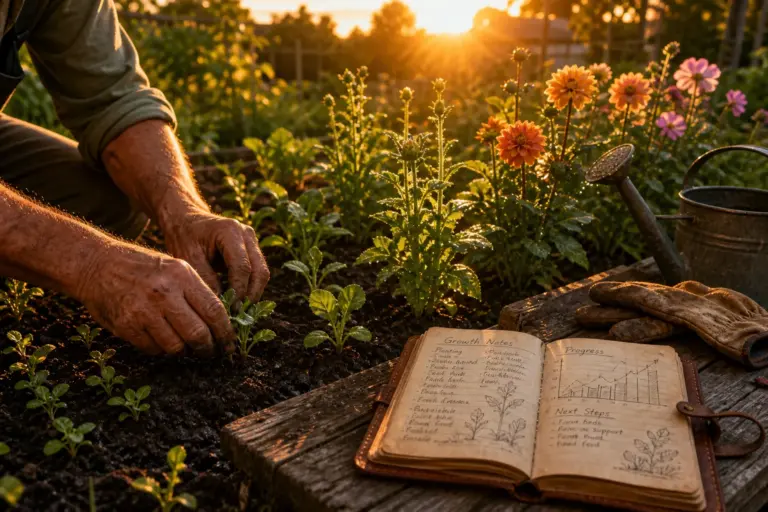
Here is a truth that most productivity content overlooks: not all growth is visible. Before a seed breaks the surface, it has already been doing the most critical work underground. The absence of visible fruit is not proof that the roots are failing.
Joseph spent years in a pit and a prison before he stood before Pharaoh. Abraham waited decades for the son God had promised him. David was anointed king and then went back to tending sheep. In every one of these lives, the gap between promise and fulfillment looked, from the outside, like nothing was happening. But God was building something that could not be rushed.
Galatians 6:9 puts it plainly: “And let us not be weary in well doing: for in due season we shall reap, if we faint not.” The condition is not perfection. It is not speed. It is simply not fainting — not quitting before the due season arrives.
If you are in a slow season right now, consider exploring finding purpose in difficult seasons as a way to reframe what this waiting time is producing in you.
Resilience When Progress Is Slow: What It Actually Looks Like
Resilience is often portrayed as dramatic — the comeback story, the triumphant return. But resilience when progress is slow looks much quieter. It looks like showing up again on Tuesday. It looks like continuing to pray when the answer has not come. It looks like maintaining your integrity and your habits even when no one is applauding.
The Mayo Clinic describes resilience not as a trait you either have or do not have, but as a set of skills that can be deliberately built. One of the most important of those skills is the ability to maintain meaning and purpose even when outcomes are uncertain.
That is where faith enters with tremendous practical power. When your goal is rooted in something larger than the goal itself — when your work is offered as service to God and to others — the absence of visible results does not strip your work of meaning. You are not just chasing an outcome. You are being faithful to a calling.
This is also why staying consistent when you feel like giving up is not simply a willpower exercise. It is a spiritual practice.
How to Persevere Through Slow Seasons: A Practical Action Plan
Resilience during stagnation is not passive. It requires deliberate, structured action. Here is a practical framework to help you hold the line without burning out:
1. Audit Your Inputs, Not Just Your Outputs
When results are slow, resist the urge to only measure what you are producing. Measure what you are putting in. Are your habits consistent? Is your effort genuine? If the inputs are sound, the outputs are a timing issue, not a character issue. Separate what you control from what you cannot.
2. Reduce the Review Window
Reviewing a year of slow progress every day is demoralizing. Shrink your review window. Celebrate weekly disciplines, not just monthly results. Did you show up today? Did you do what you committed to do? That is a win. Train your mind to recognize faithfulness as forward movement.
3. Protect Your Anchor Habits
In slow seasons, it is tempting to abandon your foundational routines because they seem to be producing nothing. Do not. Your anchor habits — prayer, Scripture, exercise, sleep, structured work time — are the infrastructure that holds you together until the season changes. Guarding your discipline when motivation disappears is what separates those who break through from those who step away just before the breakthrough.
4. Speak With Someone Who Has Waited Well
Isolation amplifies discouragement. Find someone — a mentor, a pastor, a trusted friend — who has navigated a season of slow progress and come through it with their faith intact. Their testimony will not fix your timeline, but it will remind you that the timeline is survivable.
5. Recommit to the Why, Not Just the What
When results are absent, your reasons for continuing become your fuel. Revisit why you started. Write it down again. The commitment to your goals does not have to feel electric every day. It has to be chosen — deliberately, repeatedly, and sometimes quietly.
6. Practice Patience as a Discipline
Patience is not passive resignation. It is active trust. Romans 5:3–4 teaches that “tribulation worketh patience; and patience, experience; and experience, hope.” Patience is on the path to hope, not a detour from it. Developing a practical approach to mastering patience can transform how you experience slow seasons altogether.
7. Let Consistency Become Your Evidence
When external results are absent, internal consistency becomes your proof of progress. Every day you show up is a data point. It is evidence of character being formed, capacity being built, and faithfulness being demonstrated. Growing through consistency is not always glamorous, but it is almost always permanent.
Staying Strong When Nothing Is Working: A Word on Burnout
There is a difference between a hard season and an unsustainable one. Staying strong when nothing is working does not mean ignoring your limits. Rest is not defeat. Stepping back to pray, reassess, and recover your perspective is not quitting — it is wisdom.
The National Institute of Mental Health notes that chronic stress without adequate recovery leads to physical and cognitive breakdown. God built rest into the rhythm of creation for a reason. Even Jesus withdrew from the crowds. Taking care of yourself in a slow season is not a lack of faith — it is stewardship of the body and mind God gave you to run this race.
Building sustainable habits for personal growth means building in recovery, reflection, and renewal alongside effort. Endurance is not white-knuckling through exhaustion. It is pacing yourself for the long road.
How to Keep Going When Progress Feels Impossible: Hold the Line
You may not be able to see what this season is producing. That is okay. Faith has always operated in the space between the promise and the evidence. Hebrews 11:1 defines it directly: “Now faith is the substance of things hoped for, the evidence of things not seen.”
Knowing how to keep going when progress feels impossible ultimately comes down to this: anchor yourself to what is true rather than what is visible. What is true is that your faithfulness matters. What is true is that God is not slow according to human timelines. What is true is that the seed underground is not dead — it is becoming.
Keep going. Not because results are guaranteed on your schedule, but because the One who called you is faithful to complete what He has begun. Philippians 1:6 offers this confidence: “Being confident of this very thing, that he which hath begun a good work in you will perform it until the day of Jesus Christ.”
That is enough to stand on. It is enough to keep going.
Frequently Asked Questions
Why does progress sometimes feel slow even when you are doing everything right?
Progress often operates beneath the surface before it becomes visible. Skill development, relationship building, character formation, and compounding effort all work on timelines that do not always align with daily or even monthly observation. Research in behavioral science consistently shows that meaningful change tends to be nonlinear — long plateaus interrupted by sudden leaps. Doing the right things does not always produce immediate feedback. It produces eventual results, often all at once, after a long invisible accumulation period. Trust the process even when the process seems silent.
What does the Bible say about persevering through seasons of slow growth?
Scripture addresses this directly and repeatedly. James 1:3–4 teaches that the testing of faith produces patience, and patience produces a complete and mature work. Psalm 37:7 instructs believers to “Rest in the LORD, and wait patiently for him.” Isaiah 40:31 promises that those who wait upon the Lord will renew their strength. The consistent biblical message is that waiting is not wasted time — it is formative time. God uses slow seasons to build the depth of character that visible success requires. The promise in Galatians 6:9 is not that results will come fast, but that they will come in due season to those who do not give up.
How can you tell the difference between a season of waiting and a sign you need to change direction?
This is one of the most important questions in any slow season, and it deserves honest discernment rather than a quick answer. A few markers can help. If your inputs are genuinely consistent and your approach is sound, continued effort with patience is usually appropriate. If you have received no confirmation, no open door, no internal witness from the Holy Spirit, and wise counsel from trusted advisors consistently points another way — it may be time to seek guidance about a course correction. Waiting and adjusting are not opposites. Seek God in prayer, consult trusted mentors, and examine whether your discomfort is the friction of growth or the signal of misalignment. The process of discerning God’s will involves Scripture, prayer, community, and an honest assessment of the fruit your current path is producing over time.